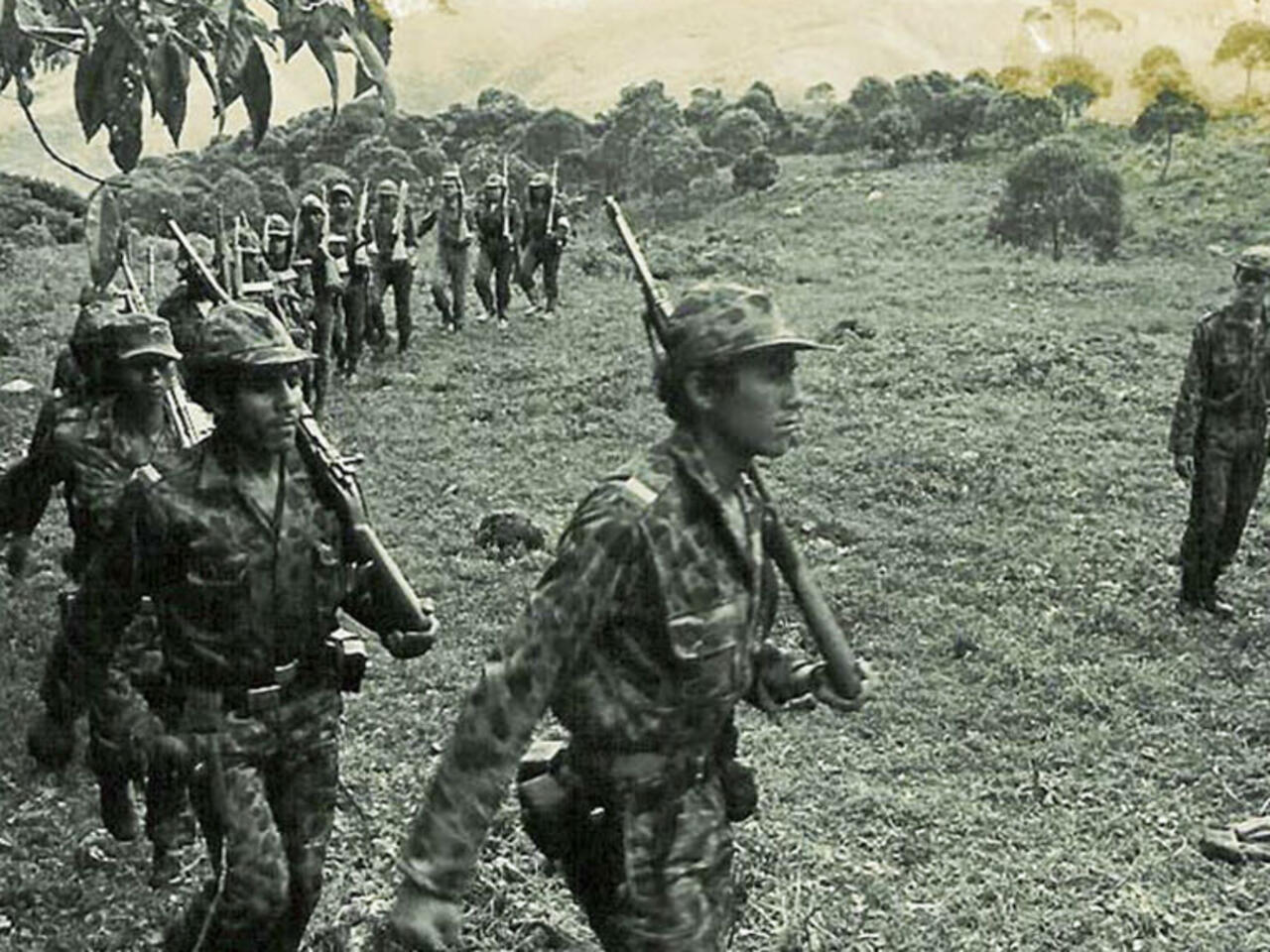
Pushed into Colombia's ungoverned frontier regions with no land, no state support, and no political voice, displaced peasants began to organize. In 1964, the Revolutionary Armed Forces of Colombia — known as the FARC — emerged from precisely these communities, rooted in the peasant self-defense groups that had formed in the aftermath of La Violencia. The National Liberation Army, the ELN, followed shortly after, drawing heavily from students and rural workers inspired by the Cuban Revolution. Both groups framed their struggle explicitly around land — demanding the forced redistribution of the great estates, the dismantling of the latifundio system, and the return of territory to the campesino communities that had worked it for generations. What began as localized acts of resistance in remote jungle and mountain regions would grow, over the following decades, into one of the longest and most devastating insurgencies in Latin American history.
As the FARC and ELN expanded their territorial control through the 1970s and 1980s, Colombia's landed elite responded not with negotiation but with force. Large landowners and cattle ranchers began financing and organizing private paramilitary armies — most notably the United Self-Defense Forces of Colombia, known as the AUC — specifically tasked with eliminating guerrilla presence in rural areas and terrorizing the peasant communities suspected of supporting them. These groups operated with the tacit approval, and in many documented cases the direct collaboration, of elements within the Colombian military and political establishment. Massacres of entire villages, forced disappearances, and mass displacement became systematic tools of counter-insurgency. Rather than addressing the land grievances that had given rise to the guerrillas in the first place, the Colombian state chose to militarize the conflict — ensuring that what had begun as a peasant land struggle would escalate into a full-scale civil war that would consume the country for decades.